A small droid in a tower full of bigger ones. It can't win a fair fight, so it steals.
What it is
KLEPTO is a remake, of sorts, of Quazatron, which Steve Turner wrote for the ZX Spectrum and Hewson published in 1986. It was itself a Spectrum take on Andrew Braybrook's Paradroid. In both you play a weak droid that can latch on to other droids, beat them in a circuit-board duel and take something from them. In Quazatron that something was their parts.
I wanted to keep that idea, the isometric platforms and the duel, and build a deeper game around them. The droid you play is still called KLP-2, which is where the name comes from.
How a run works
KLP-2 wakes in the rubbish at the bottom of the tower, wiped. It climbs from the Heap: five decks, then the Mainframe at the top. The first time it reaches each deck, a memory comes back, drawn in the 1986 style, and between them they tell what it found out before the wipe. Beat the Mainframe and you see the ending, out on the roof; after that you can climb again under pressure, which makes the tower harder and pays more data.
Each deck is stitched together from hand-made rooms, so the layout changes every run but every room was designed.
KLP-2 starts with wheels and a bumper. It has three sockets, for a drive, an arm and a core, and there are nine parts to steal: thrusters, hover, treads, a laser, an arc coil, a tractor beam, a shield, a cloak and a phase core.
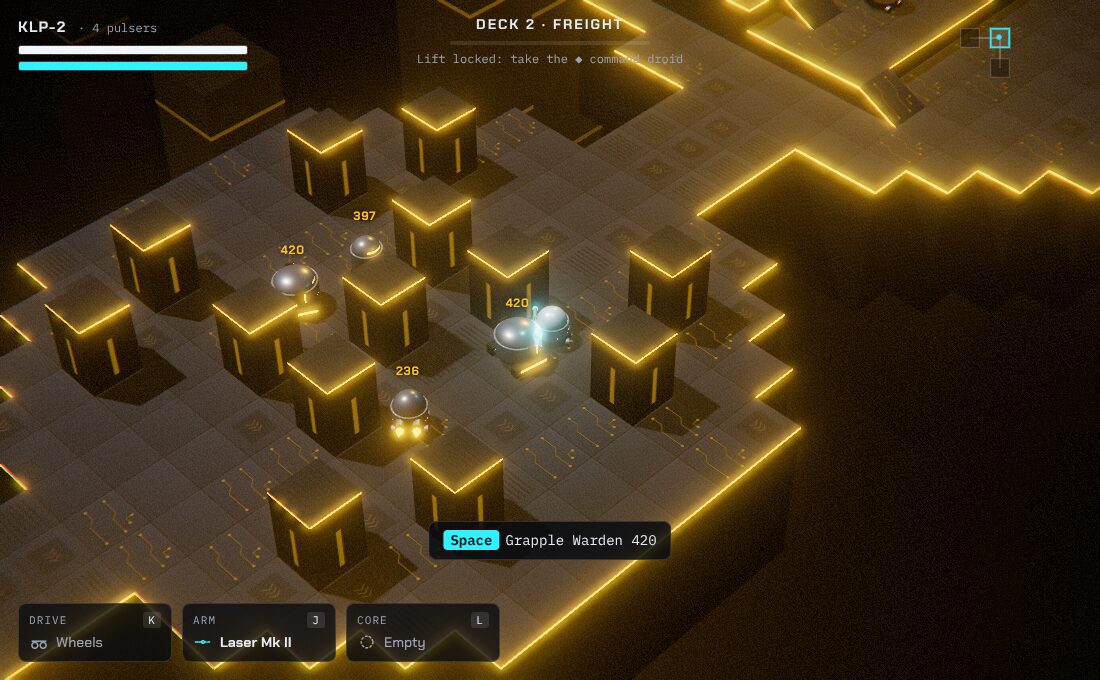
Every droid is built from the parts it carries, and it fights with them. What you see on a droid is what you can take from it. A part's grade comes from the class number of the droid you took it from.
A droid in full working order is sealed: a grapple bounces off and a shove barely moves it. Wear it down past the line on its health bar and it opens, ready to hack or shove out. Recruits keep the damage you did.
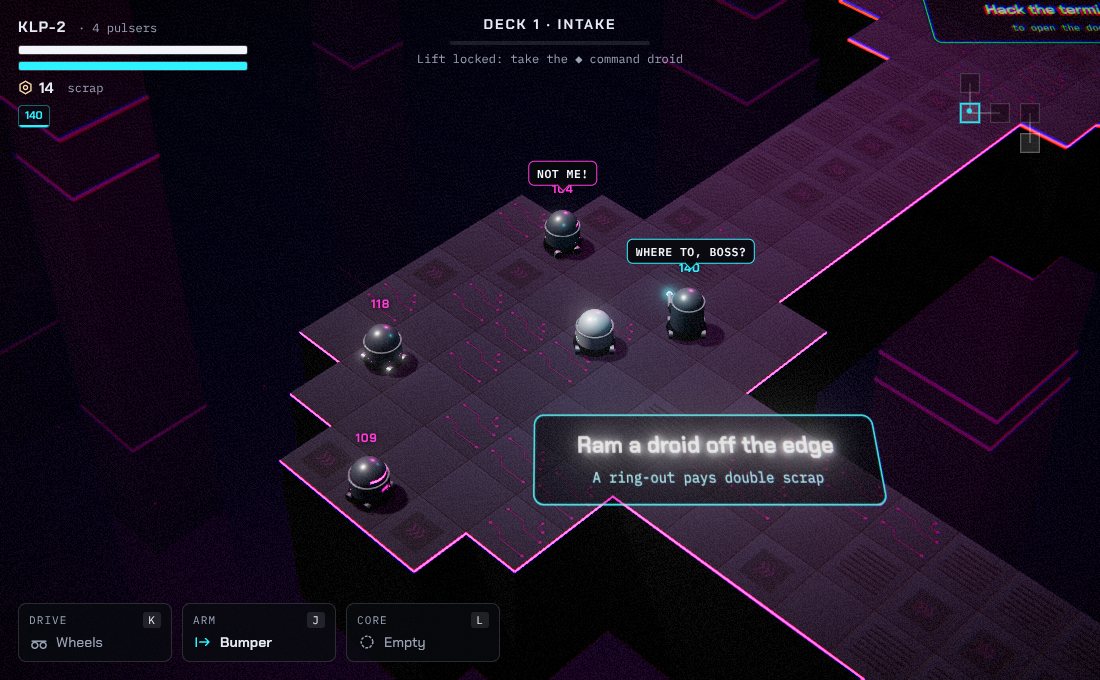
Fights are about position. Shove a droid into a wall and it's slammed and stunned; into another droid and both get it; off an edge and it's gone. A stunned droid takes double damage, and every attack is painted on the floor before it lands.
Each room with droids in it holds a caged prize, which opens once you've dealt with them all.
Beat a droid in a hack and you choose: take a part, turn it cyan so it joins your gang, or strip it for scrap. Scrap also bursts out of anything you wreck, and buys repairs, upgrades and firmware at a fabricator.
One droid on each deck is a bounty, with a name, a gold ring and parts two grades better than its class. You'll know it when you see it.
Some rooms are sealed vaults that need a particular part: thrusters for a gap, treads for a heavy crate, phase for a force field. The way up never needs one, so a run can't jam.
Each deck's lift is locked until you beat its boss, by hack or by force.
Progress comes in two kinds, and the game keeps them apart. Everything KLP-2 carries is for this run only: parts, scrap, firmware, the gang. When it's wrecked, its bits fall down the scrap chute to the Heap, where Nan rebuilds it, and all of that is gone. Data isn't: hacking downloads it, it falls down the chute to Nan whatever happens, and she turns it into small repairs that stay. Any part you have ever stolen can come back up the chute with you. On screen, gold is this run and cyan is kept.
There's a cast: Nan in the Heap, Static on the radio, Ledger in every fabricator, and the Mainframe at the top. They remember how your runs went.
The droid archive is a field guide that fills in as you see and hack each kind of droid, with notes from Nan in the margins and pages for the cast.
Your first run starts with the induction, a hand-built first deck with signs on the floor and a gate on each lesson. Today's tower gives everyone the same five decks for the day.
The hack
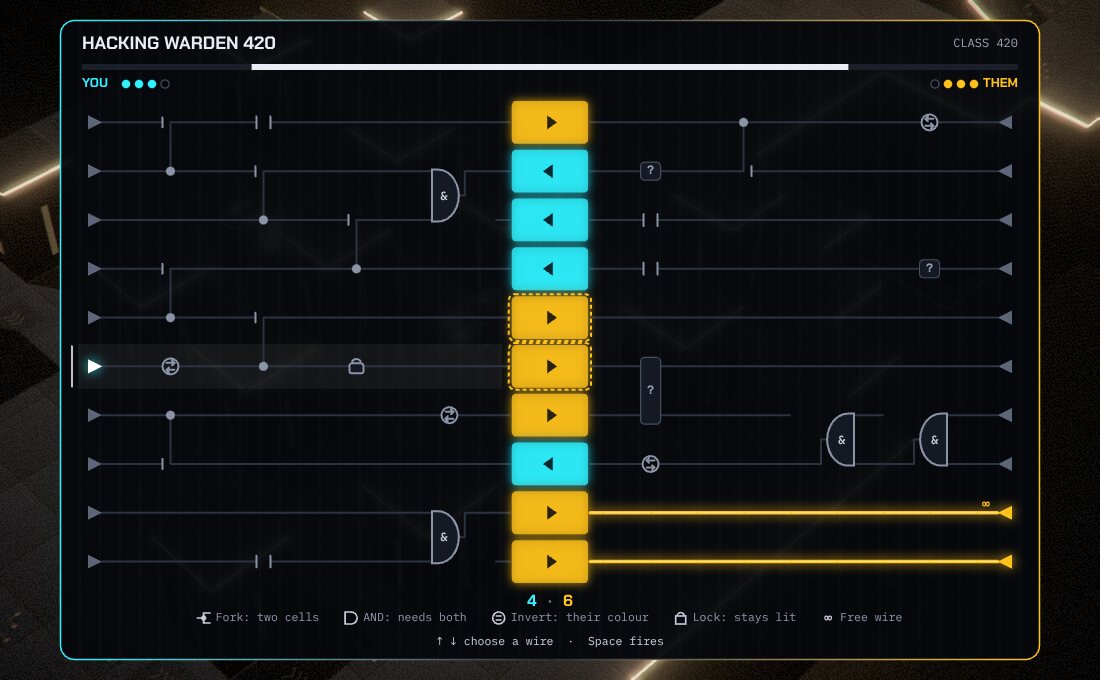
Grapple a droid and you're dropped into its circuits. Two sides of a board fight over a column of cells in the middle. You pick the side whose wires look better, then fire pulses down them. A powered cell turns your colour. Own more cells when the timer runs out and the droid is yours.
The wires carry parts that change the sums: forks that reach two cells, AND gates that need two pulses at once, inverts that paint your opponent's colour, locks that stay lit, and the odd free wire. A droid in full working order is sealed: you have to wear it down past a line on its health bar before you can grapple it at all, and the further down it is, the fewer pulsers it fights back with. Stun it and it starts late. Grapple it from a cloak and you ambush it.
You don't meet all of that at once. The first hack is four plain wires against a slow opponent. Each one you win brings in one new part, on a small board built around it, with a line saying what it does.
The colours
Quazatron on the Spectrum was mostly one colour on black, because the machine could only manage two colours in any 8 by 8 block of pixels. KLEPTO borrows that idea rather than the look. Each deck takes one ink from the Spectrum's palette as its hostile colour. KLP-2 is always cyan. As you hack and wreck the deck's machines, its light drifts from the hostile colour to cyan, so you can see how much of it you've claimed.
There is also a 1986 mode in the settings, which draws the game the way the Spectrum would have had to: 192 lines, black paper and one bright ink in each 8 by 8 block. Where KLP-2's cyan meets a magenta wall, one of them has to give. That's attribute clash. It's drawn as line art, the way Quazatron was: outlines of the shapes, droids filled in solid.
How it's made
I don't write code. I described what I wanted to Claude, Anthropic's AI model, working in Claude Code, and it did the typing, the testing and a good deal of the design. My part was the brief, the decisions and the fussing.
It's built with three.js in plain JavaScript, with no build step. It runs as static files.
There are no image files in the game. Floors, walls and displays are drawn on canvases when it loads; droids are put together from simple shapes, and the archive photographs them in a small studio of its own.
Every sound is made in the browser with the Web Audio API, including a small score for each deck that gets busier when you're in a fight.
The fonts are Chakra Petch, IBM Plex and, for Nan's handwriting, Kalam, all under the Open Font License and served from this site.
It's desktop only, played with a keyboard or a gamepad. The movement and the timed hack both want quick, precise input, and touch controls would have been a poor copy. A controller paired to a phone will work.
The menus are real buttons, so they work by keyboard, gamepad and screen reader, and the game announces what happens. It follows your system's reduced motion setting, and there are options to take less damage and slow the hack timer. The action itself still needs sight and quick hands, and I won't pretend otherwise.
Your settings, the archive and your records are kept in your browser and go nowhere else.
Diary
Newest first.
Signs for a gamepad
The floor signs already showed a controller's buttons once you used one, but plenty of the teaching didn't: the "Now hack it" call-out, the hack's own signs, the title screen and the memories all said Space and Escape. Now the moment the browser sees a gamepad (which, for privacy, is when you first press one of its buttons) every sign, prompt and caption switches to its buttons, and back again if you touch the keyboard.
A clock you can't miss, and 1986 redrawn
The hack's clock was a thin line and a small number, and you only noticed it when it ran out. Now it's a thick bar burning in from both ends, with a notch for every second. It turns amber past halfway and red for the last three seconds, when a huge 3, 2, 1 counts down behind the board. The music hurries too: from halfway it speeds up and climbs, a step at a time, so you can hear the time going without looking.
The memories were the bigger job. I love the idea of them, old footage drawn the way the Spectrum would have drawn it, but they were too noisy to read: every floor texture came out as speckle, the droids were dithered into checkerboards, and the slowly turning camera made all of it crawl. Claude rebuilt the effect from the ground up. The outlines now come from the shapes in the scene, not their textures, so floors are black and walls and platforms are clean lines. Droids are filled in solid, with their visors and wheels cut out in black. It's still 192 lines and one ink per block, and it looks a lot more like Quazatron did. The camera holds still for the memories, and the caption sits on solid black. The 1986 mode setting uses the same drawing, so the whole game is now playable in it.
Photograph: Static
The Tower Gazette, the newspaper at the end of every run, has pictures now. The main one is the moment KLP-2 was wrecked, framed on KLP-2 and whatever got it: a Hauler, a boss, the edge of the deck. Win, and it's KLP-2 on the roof. Walk away mid-run and it's the last place you were seen. A smaller picture, "Also in this issue", shows the biggest thing you did on the way: a boss going down, a bounty claimed, a ring-out, KLP-1 dropping in.
They're printed the way an old newspaper would print them: black and white, as a screen of dots, a little grainy, each with a caption written from the run. The tower is mostly dark with bright neon in it, which made the first attempts look like night-time photos of a firework, so the printing lifts the middle tones and lets the brightest lights burn out.
The archive keeps your last ten front pages, pictures and all, under Back issues, so you can look back at how your earlier runs went wrong.
Teaching the loop
Feedback from people who aren't me: they were missing the whole point. The first room said "Bump it with J till it opens", then, in smaller type, "then Space to grapple it". So people bumped the Mite, watched it run off, and never hacked anything. The hack explained itself in one small line along the top of the board, which nobody reads with a clock running.
Claude played it through as someone who had never seen it, and the first room now goes like this. The sign says "Ram it with J". The Mite cowers rather than running away. The moment its seal breaks, the game slows to a stop, the Mite glows, and a big sign over it says "It's open. Now hack it", with the Space key. Nothing moves until you press it. That happens once, the first time you ever break a droid open.
The first hack is now a walk-through, in big signs like the ones on the floor: these are your wires; pick one; fire it; that cell is yours; now take more before the clock runs out. The clock and the Mite wait until you've seen your first cell change colour, and losing a hack in the induction does no harm. Every new part after that gets its own big sign before the board starts, rather than a line you'd skim.
A strip across the top of the induction spells out the loop: ram it open, hack it, then take what it's got. The step you're on lights up and the ones behind you tick off, once for the Mite and again for the Spark.
A fix the same day: I couldn't see any of the new hack signs myself, because my save had already passed every hack lesson, so the induction gave me ordinary boards. Now the induction teaches the hack every time it's played, whatever you've learned before, without undoing your progress.
An induction you can't get round
Two things I noticed playing the induction. The floor signs cut off their own words: each sign had a fixed width, and some lines were longer than it. Now a sign measures its words and sizes itself to fit, for keyboard or pad, and only shrinks the type if it would get too wide for its room.
And you could skip a lesson by accident. Knock the Mite that's there to teach hacking off the edge, or wreck the Spark before you hack it, and the lesson was gone, and with the Spark went the laser the next room needs. Now the droids that are there to be hacked can't be wrecked or put over the edge: they brace, and if one falls anyway it comes back. The Mites on the ledge, which are there to be knocked off, can't be wrecked before they go. Hacking the Spark offers its laser and nothing else, so nobody turns it or strips it for scrap and then wonders why the bridge won't come up.
The site has a card now, too, for when someone shares a link: KLP-2 among the droids on a magenta platform, with the title beside it.
Saying less
Five stages of new things left the game talking over itself. I asked Claude to go through everything it says, and the start of a deck was the worst of it. The boss's name was on the deck card, in the HUD, over the boss and in a tip, and Static said it on the radio too. The bounty's name was on the card, in the HUD, on the radio, on a banner and over its head. Static could get through six messages before you'd moved. All told there were 15 kinds of tip and about 30 kinds of toast, and some news arrived three ways at once.
So a deck now starts with its name and nothing else. Static says one thing at most, and only if it's new: what's on a deck the first time you get there, or a word about the deck you've just left. Bosses and bounties are explained once, by Static, the first time you set eyes on one; after that the name over its head does the job. The HUD's deck panel is down to the deck, how much you've claimed and what the lift needs. Tips come one at a time, never in a deck's first few seconds, and in fewer words. Toasts that only repeated a banner, a counter or a socket have gone, though a screen reader still hears them.
The induction gets the same treatment. Its floor signs do the teaching, so there are no tips on top of them. And each lesson room is now shut by a force field that drops once you've dealt with its droids, who are kept to their own room. Before, the droids from one lesson would wander into the next and the whole thing turned into a brawl, which is not much of an induction.
The roof, and climbing it again
The last of the five stages. Beat the Mainframe now and the uplink comes down, and you see it happen: not in the 1986 style of the memories, because this isn't a memory. All through the tower every droid stops, blinks and is itself again. The ones around you turn cyan. Static can hear everyone at once on every frequency. KLP-2 rides the last lift out onto the roof, and the city out there is still its own. Nan has the kettle on. Then the Tower Gazette prints a special edition: MERGE CANCELLED.
Getting to the roof once shouldn't be the end, so now it isn't. Once you've been there, the chute asks how hard you want the climb: each notch of pressure makes the droids tougher and harder-hitting, and from the second notch the bosses hack back with an extra pulser, but the data pays more. Reach the roof under one notch and the next unlocks, up to five.
That's the redesign done: sealed and open droids, the tower the right way up, a clear line between what you keep and what you lose, a broken KLP-2 that you mend and can see mended, bosses wearing pieces of you, a story told in memories, and an ending. It took five stages and a day. I suspect it'll need a week of playing to tune.
Waking up, and remembering
KLEPTO has a story now. A new game starts on a black screen with KLP-2 booting up: power 11%, chassis damaged, memory wiped, location unknown. Then Nan finds it in the rubbish. It came down the chute three nights ago, in bits. It's a maintenance unit, she thinks, and someone has wiped it clean. Whatever happened to it happened up in the tower, so up it goes. The first climb is the hand-built deck with signs on the floor, and at the top of it is the Sorter, wearing a piece of you.
The first time you reach each deck after that, a memory comes back before the deck starts. Each one is a short scene, staged with the game's own droids and drawn the way the Spectrum would have drawn it, in the 1986 mode, like old footage, with a caption typed underneath. In five memories you find out who KLP-2 was, and KLP-1, what was behind a wall on Reactor, the word the Marshal used, and how it ended. The word was the Merge: every droid in the tower, then the city, made into one mind. KLP-2 got to the uplink at the top and cut a cable before they caught it.
Nan and Static have things to say as it comes back to you, and the archive keeps every memory you've recovered, written out, so you can read them again.
Bosses, and pieces of you
This was my one addition to the plan: some progress should feel like a moment, not a purchase. So each deck's ◆ command droid is now its boss, with a name: the Sorter on Intake, the Quartermaster on Freight, the Stoker, the Marshal and the Director. When KLP-2 was wiped, its best parts were handed round them like medals, and each boss wears two, glowing cyan on its back.
Beat one, by hack or by force, and you choose which piece to take back. It's yours for good, it does something you'll notice, and it shows on KLP-2. The old claw makes droids open sooner. The ram plate hits harder. The capacitor brings energy back faster. The optic sees through cloaks. The override brings recruits in whole. The piece you don't take stays with the boss until you beat it again, on another run, so there's always a reason to go back. Static tells you which boss is still wearing what.
The first bosses are gentler than the later ones, so a new player gets their first piece early. In 48 runs each, the test bot did about as well with the bosses as without.
Broken, then mended
KLP-2 now comes out of the rubbish in a bad way, and looks it: a dull, scuffed shell with holes in it and wiring glowing inside, a panel flapping at the back, a visor that sputters, one wobbly wheel and no aerial. It fizzes as it rolls. It starts with 60 integrity and 60 energy, its weakest yet.
Nan's bench is now a list of repairs to KLP-2 itself, and each one shows. Hull plating patches the holes and polishes the shell until a lit trim appears; power cells steady the visor and add a second line to it; wheel bearings stop the wobble; the logic board gives back its aerial, bent at first. The bench shows KLP-2 turning beside the list, and it flashes when a repair lands, so you see what you've paid for. Under its name in the HUD there's a word for how mended it is, from scrap to gleaming. The first notches are cheap, so one decent run buys a repair you can see.
The test bot gets past deck 1 a little less often at 60 than it did at 70, which is the point. Because the game now starts in a different place, old saves start again, keeping settings, the archive and the hack lessons.
The right way up, and what you keep
KLP-2 now starts at the bottom and climbs. The Heap, where Nan lives, is where the tower's rubbish lands, at the foot of the scrap chute. Each run you climb the chute into Intake and ride the lifts up through Freight, Reactor, Security and Command to the Mainframe at the top. When you're wrecked, your bits fall back down the chute to Nan, so the story finally agrees with gravity. The chute in the Heap is now a shaft of light, with bits of data drifting down it.
I also wanted a new player to understand, without being told twice, what they keep. Everything you carry is for this run only: parts, scrap, firmware, your gang. Data is the one thing that lasts, and Nan turns it into repairs. The game now says so everywhere, in two colours, gold for this run and cyan for kept. The scrap and data counters are labelled. Tab opens a KLP-2 sheet that splits every stat into the two. And the end-of-run newspaper finishes with what you kept and, crossed out, what went with you; the first time, it says why.
Next, KLP-2 starts broken, and you watch him mend.
Sealed, then open
This is the start of the biggest change since the first playable run. I'd felt for a while that something was missing, and part of it was that fighting and hacking didn't feed each other. You could grapple a droid in perfect health, or shove nearly anything off an edge.
Now a droid in full working order is sealed. A grapple bounces off, a shove only half moves it, and it braces itself at edges. Wear one down past the white line on its health bar and it sparks open, fizzing cyan, and it's yours to deal with: hack it, or shove it out.
The further down it goes, the easier the hack. Open, it hacks back with a pulser fewer; critical, past a fainter second line, two fewer. But a recruit now keeps the damage you did, and hits about as hard as it looks, so smashing a droid nearly to bits buys an easy hack and a frail friend. Shields matter more too: a jab or a bolt bounces off, but a full shove, a dash or a jolt from the arc coil breaks the guard.
Claude tried the line at half health first. The test bot, which doesn't dodge, did noticeably worse, so the line sits at 60%, about where the old first dent was, and the bot gets as far as it used to.
This is the first of five stages. Next, the tower turns the right way up.
A field guide, a manual, and Static on the bounty
The droid archive was a grid of text boxes. Now it's a field guide. Each droid has a page with its real model turning on a plinth, lit in the colour of the deck it lives on, and the page fills in as you go: a dark outline until you've seen one, then its habits and something it says, then its parts, its numbers and how to take one after your first hack. Hack three and the page is stamped complete, and some data goes up the chute to Nan. She has written in the margins, by hand ("They fire in straight lines. Don't stand in straight lines. That's the whole trick."), and adds a second note when a page is finished. The cast have pages too, which keep every story line you've heard and count the ones you haven't.
How to play was the plainest screen in the game: one long page of grey text. It's now a manual in the same kind of book, with twelve short chapters, each with a drawing made of the game's own shapes: the lock-on bracket, a shove into a wall, a floor warning and a swerve, a hack board with its forks and gates.
And Static now names each deck's bounty on the radio as the deck starts, often with a tip ("Grudge has a Mk VI shield and thinks that makes it clever. A Warden, shield up. Go round the side."). Checking that, Claude found that nearly half of all runs met the same bounty name twice, which would have stood out once Static started saying them aloud. Each run now deals out different names.
The Tower Gazette, and KLP-1
Two extras I said yes to. The end of a run is now the front page of the tower's newspaper, written from what happened. The headline goes to the most newsworthy thing you did ("FOUR STAFF LOST TO VOID IN KLP RAMPAGE"), the copy is built from your numbers, and the quotes are things the droids actually say. There's a weather report, and the classified ads are mostly Ledger.
And a rival. Once you've had a few runs, KLP-1 starts turning up: the KLP that Nan built before you, sent down the chute, and never got back as itself. It has thrusters, a laser, a shield and opinions about you ("SO NAN BUILT ANOTHER ONE."). It doesn't join gangs. Beat it in a hack three times, across however many runs that takes, and you can bring it home to the Heap, where it stands about being awkward with Nan.
The hack, redrawn
I like the hack, but it looked like a diagram. Now it's a circuit board. Unlit wires are copper traces; lit ones glow in the colour they'll paint, with light running along them towards the middle, and each pulse runs down its wire like a comet. The cells are glass capsules that fill with light from the side that takes them, with a splash and a note when they change hands.
Across the top, a tug of war shows who owns more cells right now, so you don't have to count, and a fuse burns in from both ends, with the seconds in a clock between. And there are faces: KLP-2 on its side, the droid you're inside on the other. They look smug when they're ahead and sweat when they're behind, and the droid talks in its own voice. A Spark reminds you it's a restricted system; a Warden says no. A new board draws itself in from the edges, and at the end the winner's colour washes out over it.
Everything that made it readable stays: the arrows on each cell, the key, the wire hints and the lesson boards. With reduced motion on, the board appears at once and nothing flows or bobs.
A home, a cast, and getting stronger
The other thing I took from Hades: the people. KLEPTO had nobody in it but you and the droids you were fighting. Now there's a home, and a cast.
When KLP-2 is wrecked, its bits go up the scrap chute to the Heap, where the tower's rejects live. Nan, an old welder from Freight, puts you back together and has something to say about how you died ("Shot by a Spark. They can't even spell halt."). Static runs a pirate radio and talks to you in the lift between decks: what's below, and what he made of the deck you've just left. Ledger runs every fabricator in the tower through its screen, and is not your friend. The Mainframe has a line on every deck card and gets ruder the deeper you go. They remember how far you got, what killed you and which bounty you brought down, and most lines play only once.
The other half is progression. I didn't feel I was getting stronger through effort; the power came in lumps. So KLP-2 now leaves the Heap weaker, with 70 integrity and 70 energy instead of 100. Hacking downloads data, which goes up the chute to Nan whatever happens to you, and she sells small permanent upgrades for it, a notch at a time: five more integrity, five more energy, a little speed, half a second more on every hack. Ledger sells small notches for the run, too. Every upgrade now says what it changes, in numbers: "Laser Mk II → Mk III: 9 → 11 a hit".
How weak is weak? Claude ran the bot that plays whole runs at different starting strengths. At 100 it averaged three decks; at 60, under two, with four runs in ten ending on deck one. 70 came out at a little over two, which is about the "a little weaker" I asked for. Six notches of Nan's Plating gets you back to 100.
Today's tower ignores all of this: everyone starts it with 80 and 80 and no starting part, so it stays fair. And deck six's card no longer calls it the top of the tower, when the lift has been going down the whole way.
Droids with something to say
I loved the speech bubbles, but the droids were still a bit functional: any of them could have said any line. Now each family has its own voice, worked out from its job and its parts. Mites are cleaners and frightened of everything ("I JUST MOPPED THAT."). Sparks go by the rulebook ("HALT. PAPERWORK."). Couriers are always late, Haulers are slow and quite friendly, Wardens barely speak, Overseers are middle managers, and Phantoms whisper, in lower case. They have lines for spotting you, winding up an attack, getting hurt, running away, losing sight of you, winning or losing a hack, and joining your gang.
They talk to each other, too, before they notice you: about lunch, the Mainframe and, once you've been at it a while, you. "ONE GOT TO DECK 3 LAST TIME." While two droids are chatting they're less watchful, which makes it a good moment to creep up.
And they move like themselves. Mites sweep from side to side as they go and shake when they run. Couriers rev on the spot and run errands at speed. Haulers sway and plod. Sentries stand and look round; Wardens stand their ground. A "!" pops up when one spots you and a "?" when it gives up looking. A stunned droid wobbles with stars round its head, and one that beats you in a hack does a little spin.
Fights you can win on purpose
The big review. I love how the tower looks, but playing it felt like wandering about hoping to bump into someone. Shooting was fiddly and you couldn't tell what a shot was worth. This is the first of five updates to fix the game rather than decorate it.
The cause of the fiddliness: KLP-2 aimed wherever it was rolling, so to shoot a droid you had to drive at it, and the game quietly chose a target for you. Now a cyan bracket sits under the droid your arm will hit, and you fire at it whichever way you're going, so you can back off and shoot. On a gamepad the right stick picks.
The bumper is a proper weapon. Tap it for a jab, or hold it and an arrow grows on the floor; let go and KLP-2 launches. Knock a droid into a wall and it's slammed, hurt and stunned. Into another droid and you get a pile-up. A stunned droid takes double damage, so there are combinations now: stun it with a slam, hit it while it's down, then grapple it before it recovers and it starts the hack late.
Wheels can swerve, a quick sidestep that shots pass straight through. In return, every droid paints its attack on the floor before it lands: a line for a laser, a lane for a charge, a ring for a stamp. The warning follows you until a moment before, then stops. That's when to move.
Hits say what they did: numbers off every hit, SLAM and PILE-UP when they happen, and two marks on each droid's health bar at the points where it hacks back with a pulser fewer. Cross one and it says DENTED. Part cards now show their numbers too.
And rooms have a point. Each one with droids in it holds a prize in a cage: scrap, a repair kit, parts or firmware. Deal with every droid from that room and the cage opens. The map shows where the prizes are.
Along the way Claude found a bug that could leave KLP-2 stuck for good at the foot of a ledge, if it dropped off slowly and landed against the edge. It now always lets you roll away from a wall you're caught on.
Saying what the bars mean, and a bounty you can't miss
I had to ask what the two lines in the top left were. One was integrity, KLP-2's health; the other was energy, which your parts run on. Neither said so. If the person who asked for the game can't read its screen, nobody can.
The corner is now a proper panel. Each bar has its name, an icon and a number, so integrity reads "64/100" and turns red below a third. Energy says what it's for. Scrap sits in a counter by KLP-2's name, and a row of dots shows how many pulsers you take into a hack. The deck's name, how much of it you've claimed, the lift and the bounty sit together in a second panel at the top.
I'd guessed right about bounties: one droid on each deck is worth more, with parts two grades better than its class, extra scrap and a firmware chip. But you had to read its name tag to know. Now it stands in a gold ring wherever it goes. The first time you see it, a gold beam drops on it, a fanfare plays, "Bounty spotted" fills the screen with its name and what it carries, and a gold star marks its room on the map until you've dealt with it.
A proper slope for the hack
My first hack after the induction was a mess: eleven parts on my side of the board, seven of them AND gates. Claude measured the boards and found the lesson boards were to blame. They were meant to be built around the new part and had ended up buried in it, busier than the first ordinary board after the lessons.
A lesson board now carries the new part two or three times, with four or five parts in all. Ordinary boards have a budget that rises with the droid's class: about four parts on a Mite, six or seven by class 300, nine by class 400, and fewer AND gates on the small ones. From class 500 the boards are left as they were, so the end of a run is as hard as before. Small droids are also a little slower in the hack.
Damage always counted, but nothing showed it. Ram a droid before you grapple it and the board now says so, "Dented: 1 pulser down", with the lost pulser crossed out, and "Stunned: starts late" if you've stunned it. The Spark room in the induction has a new sign: ram it, then hack it.
And wire hints. While you're learning, the arrow at the start of each wire is coloured by where it lands: your colour, theirs, or grey for nowhere, with an & where a wire needs a partner. A setting keeps them on for good.
Later the same day I asked whether the hack shows how many shots you have left. It did, barely: four tiny dots that only appeared once the hack began. They're bigger now, with the number written beside them, there from the moment the board appears, and they flash if you try to fire with none left.
Colour doing more work in the hack
My suggestion: the invert should show what it does. Its ring is now split down the middle, cyan on the side your pulse comes in and their colour on the side it goes out, so on their side of the board it's the other way round.
Claude added two more. The wire you've selected now has a faint trail along it, in the colour it would paint, so you can follow a pulse through the forks before you fire, and watch it turn their colour at an invert. And an AND gate has a small light on each input, so you can see when it has one pulse and is waiting for the other. The trail stops at a hidden part, which also fixes an old leak: the dotted preview used to give away what was hiding there.
The fabricator also shows how much scrap you have, in a proper counter rather than a line of grey text.
Milestone
A gentler start, and more fun
I played it properly and found the start overwhelming. The first hack threw everything at you: eight wires, five kinds of part, a side to pick against the clock, and four pages of instructions before you'd pressed a key.
Now the hack teaches itself. The first board has four plain wires and an opponent in no hurry. Win it and the next board brings in forks, then cut wires and choosing a side, then inverts, AND gates, locks and free wires, one at a time, each on a small board built around the new part with a single line about it. The pages of instructions have gone. Hacks on small droids are a little quicker, too.
The first deck of your first run is now built by hand: the induction. Seven rooms, each bringing in one thing with a sign painted on the floor. A Mite asleep on the job to practise the hack on, a Spark with a laser to steal, a target across a gap to try it on, a ledge with three Mites on it to ram off, a terminal that opens a door, and the command droid guarding the lift. You can skip it, and replay it from the title screen. After it the run carries on with generated decks as before.
Then I asked for it to be a lot more fun, which is harder to specify. The first answer is scrap. Wrecked droids burst into it, and KLP-2 hoovers it up as it rolls past. Knock a droid off an edge and the game slows down to watch it fall, shouts RING OUT and pays double. Each deck's lift room has a fabricator where scrap buys repairs, better grades of the parts you already have, and firmware. Win a hack by four cells or more and you can take two parts instead of one.
The second answer is a gang. Win a hack and, instead of taking a part, you can turn the droid. It goes cyan, follows you about and fights for you, and it rides the lift down with you. Three at most. A turned Mite, which spent its life running away from you, now runs at other droids, and I find that more pleasing than I can justify.
The third is personality. Droids talk now, in short capital letters over their heads: they spot you, complain when you dent them and get a last word on the way into the void. Mites squeak and run. Your gang passes the odd remark on the way round.
And it's quicker all round. KLP-2 is faster than the droids now, so you can catch a Mite and line up a ram. Decks are a room or so shorter, and the grapple snaps on faster.
Each deck also has a bounty: one droid with a name, a brass shell and parts two grades better than it ought to have. Bishop, Lady Volt, Sump King. It announces itself when it sees you. Hack it for those parts, or wreck it, and either way you get a pile of scrap and a firmware chip.
Finally, an idea Claude pitched that I liked: today's tower. Everyone who plays on the same day gets the same five decks, and the first go is the one that counts. At the end you get a line of coloured squares to share, one per deck, with a bang where KLP-2 went down. I'm aware of where that idea comes from.
More rooms, and a second pair of eyes
Thirteen more rooms, so a run doesn't keep showing you the same ten. Each deck now leans towards rooms of its own: Freight gets a loading bay and a sump full of crates, Reactor gets coolant channels of live floor, Security gets a watchtower and a row of cells behind force fields.
Then a separate Claude reviewed the code cold, without being told how any of it was meant to work. It found eleven bugs. The worst: starting a new run after dying handed you back the dead droid, with one point of integrity. All fixed, and the fixes checked in a browser.
Smaller things from the same round: you can pause a hack, the camera zooms on + and -, droids turn their visors to watch you, a controller rumbles when you hit something, and winning a hack pulls a stream of light out of the machine and into KLP-2.
Milestone
First playable run
The first version that goes from the title screen to the Mainframe and back. Five decks plus the finale, fifteen families of droid, nine parts, firmware upgrades, vaults, an archive that lasts between runs, and the hack.
The hack got the most attention, since it's the heart of the thing. The original's boards were fun but opaque, so this one shows you which cells a wire will reach before you fire, and each cell carries a small arrow pointing at its owner so the board still reads without colour. A headless test pits a decent player against droids of every class: the cheap ones lose more than eight times in ten, the officers on deck 5 still win about three times in ten.
Before calling it playable, Claude wrote a bot that plays whole runs with no graphics, at speed. It found that about one deck in eleven had a lift you couldn't reach, and that KLP-2 rolled off edges far too easily. Both are fixed. Every change now gets checked against 1,800 generated decks, and KLP-2 won't drive itself off a ledge, though a ram can still put it over.
Droids came out better than I expected: little enamel domes with a lit visor and their class number on the front, like the originals, but carrying whatever they've got bolted on. A Courier has thrusters on its back. A Warden has shield fins. You learn what a part does by being on the wrong end of it first.
The brief, and three decisions
I asked for Quazatron, much improved: the isometric movement and the grappling kept, the rest made deeper and better looking, with powers you take from the machines you hack and puzzles that need the right ones.
A roguelite. Halfway through the brief it struck me that this could be a roguelite, and it fits unusually well, because the game was always about starting weak and stealing your way up. The risk with procedural levels is a puzzle you can't solve with what you've got, so the puzzles moved into optional vaults, and the generator makes sure the part that opens each vault is walking around somewhere on the same deck.
Desktop only. I worried it wouldn't work on a phone, and it doesn't really. Better to say so plainly than ship a cramped virtual joystick.
KLEPTO.Quazatron is still someone else's name, so this one is named after its hero.
Credits
Quazatron by Steve Turner, Graftgold, published by Hewson, 1986. Paradroid by Andrew Braybrook, Graftgold, published by Hewson, 1985. KLEPTO borrows their ideas, not their code or graphics, with thanks.
Made with three.js. Fonts: Chakra Petch by Cadson Demak, IBM Plex by IBM.